


The Business of Black Outrage: Racial Conflict, Controversy, & Election Cycles

By Imari Burton, Dayton Weekly News
Every few years America seems to find itself having the same conversation particularly around election seasons.
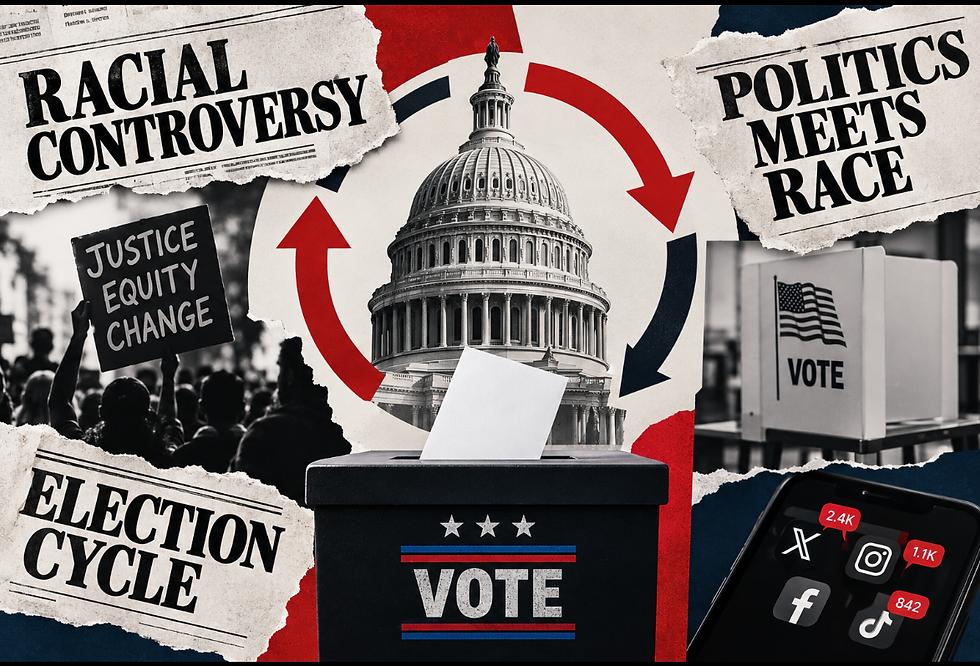
The Cycle
A Black person dies under suspicious and controversial circumstances, the case is then illuminated into the public eye. News cameras arrive. The name spreads across social media. Protestors take to streets. Politicians release statements. Corporations discover the language of racial justice and virtue signals to the public. Advertisements get scrutinized for racially charged imagery and stereotypes they release around the same time. Companies apologize. Product is pulled. The case typically gets no justice or leaves the public with more questions than answers. Campaigns lastly begin talking about the "stakes" for Black Americans on the line. Voters then mobilize to the polls…
Then eventually, the outrage fades.
We move on. Go back to shopping with the same stores, wearing the same brands, scrolling past controversy. Until yet another name enters the national conversation. Then, wash and repeat. The cycle seemingly begins again.
The Name of Outrage
For many Americans, this modern cycle can be traced back to 2012 at least, when the killing of Trayvon Martin became a national flash point and helped ignite a new era of conversations about race, policing and justice within the Black community. Then, in 2014 came Michael Brown, Eric Garner, Tamir Rice, In the year 2016 there was Alton Sterling, up till 2020 where the prominent George Floyd case triggered massive outrage resulting in one of the largest national mobilization demonstrations we've seen in the last several decades. In 2022, Jayland Walker from Akron, Ohio was targeted by 8 police officers and fatally shot resulting in mass protests and making national coverage as well. Then to follow in the year 2024, another major controversial case, regarding Sonya Massey whom was fatally shot by responding sheriff deputy after calling police believing someone was outside her home. And fast forward to present day 2026, Nolan Wells.
The list is far from exhaustive. As there are dozens of other names that could be added to this time line, of which, many became national symbols, while some generated significant regional attention, and others that disappeared from media almost as quickly as they appeared. The circumstances, cities, and legal outcomes all vary. But the recurring pattern is too difficult to ignore.
The question here isn't whether these deaths matter, because THEY DO. The bigger questions to be asked here are:
What happens when Black tragedy becomes a recurring catalyst for political mobilization, corporate messaging/signaling, media consumption and public outrage?
Further, why has the cycle continued for over a decade without resolving the underlying conditions that created it?
Ultimately somewhere between the initial tragedy and the eventual return to normalcy, an entirely new ecosystem begins to form. An ecosystem made up of actors whose motivations may be the same, or different from one another but become connected by the same event. In part, none of these actors necessarily has to be coordinating with each other for said ecosystem to exist, as each can simply be responding to the incentive in front of them…For starters, the media has an audience to capture, while social media platforms have engagement to generate, activists have causes to advance, politicians have voters to sway and mobilize, and corporations likewise have consumers to maintain.
So, what happens when those incentives repeatedly converge around the subjects of Black tragedy and racial in justice? And does the increased attention generally create accountability, or just another news cycle? Does the corporate activism produce meaningful change or simply protect the brands reputation? Is social media activism helping create sustained movements, or is it rewarding increasingly emotional and divisive content? And most importantly, does the political messaging and framework during these campaigns that follow shortly after actually lead to lasting and meaningful policy changes? or, is it actually just intensifying urgency for the upcoming elections?
In hindsight, the George Floyd BLM protests created an enormous financial movement surrounding racial justice in 2020. The Black Lives Matter Global Network Foundation (BLMGNF) reported raising $90 million that year. While supposedly distributing roughly $21.7 million in grants, and ending the year with approximately $60 million in assets. The foundation has said that much of the money was intentionally retained for long-term investment and future grants. But, when millions of Americans donated in response to a national moment of racial outrage, how much of it actually translated into measurable and direct benefits for the Black communities those donors believed they were supporting?
Where Does The Money Go?
This question became even more controversial following Candace Owens documentary The Greatest Lie Ever Sold, which further examines BLM's finances, real estate purchases, and leadership, questioning where the millions raised after George Floyd's death actually went. More recently, the BLMGNF has faced federal scrutiny over finances allegedly concerning handling of donor funds and fraud which as of September 2026 is still under current investigation with the DOJ regarding possible false statements on the organizations 2020-2021 990 IRS forms, wire fraud, and embezzlement.
Separately, this very concern actually became a documented criminal case here in Ohio. Where Sir Maejor Page, a Toledo man who operated a separate and similar organization called Black Lives Matter of Greater Atlanta, in which he was later convicted of wire fraud and money laundering. Prosecutors stated he obtained more than $450,000 from approximately 18,000 donors through "false representation" and used the money for personal expenses.
Page was sentenced to 42 months in federal prison in 2024. His conviction does not establish wrongdoing by BLMGNF, but it does demonstrate just how the public trust and enormous financial activity surrounding the 2020 BLM movement could also create opportunities for financial abuse against the very people some movements claim to protect.
This is also not to say corporations, politicians, media, etc. shouldn't respond when controversy strikes, or when consumers identify or respond to genuinely offensive ad imagery. They should respond. But moreover have the corporations become more responsive to the public, or have the companies just learned controversy itself can generate larger amounts of attention and revenue for the brand? Over the past several years, major brands have also found themselves intertwined at the center of controversies that seemingly all follow the same pattern.
Corporate Statements and Spending
And the corporate response regarding BLM went beyond public statements. As a 2021 Washington Post analysis found that Americas 50 largest public companies announced an approximate $49.5 billion in racial justice commitments following George Floyd's death, though more than 90% came through loans and investments rather than charitable donations.
McKinsey Institute for Economic Mobility followed these corporate commitments and found by May 2021, Fortune 1000 companies had made $200 billion in cumulative commitments. Also noting that how the money was actually being spent remained "unclear". These financial commitments are only part of the broader scope of corporate response to racial tension, as many companies have also found themselves increasingly under scrutiny for the imagery, symbolism, and messaging in their advertising campaigns amid racial controversies.
This isn't a new phenomenon. As in 2018, company H&M faced widespread backlash after featuring an advertisement with a Black child wearing a sweatshirt reading "coolest monkey in the jungle". H&M apologized afterwards and removed the imagery. Fast forward to present day 2026, as racial controversy once again entered the national conversation surrounding cases like Nolan Wells. Converse likewise found itself facing similar backlash over their most recent ad in which critics said evoked imagery associated with the KKK and lynching's. The timing is difficult to ignore. As September 17th, 2026, AP reports on multiple Black people found hanging with nearly 60 members of Congress calling for federal investigations from the Justice Department and to enforce the Emmett Till Antilynching Act. Then just 24 hours later, on September 18th, The Washington Post then reports on the converse advertisement. And to follow amid the already racially charged climate, on September the 22nd regarding the verdict of the Nolan Wells case, the grand jury announced it would not bring charges forward.
So, when racial controversy is already dominating public and national conversation why do images invoking that same history continue to appear simultaneously? Is the timing coincidence?
The Names Change, The Questions Don't.
Increasingly many of the most intense national conversations about race have unfolded during periods of heightened political activity. George Floyd's death in 2020 is one of the clearest examples. As his killing became a central issue in the presidential campaign immediately, both basing their campaigns heavily on racial injustice, policing, and Black voter turn out in response.
Biden once elected signed on the George Floyd Justice in Policing Act, which sought sweeping federal policing reforms, but after Biden was elected, legislation stalled in Senate and never became law. So again, what actually changes for Black Americans particularly once the outrage fades?
That question brings us back to the cycle. Always ending with the attention dying down after elections. This does not mean however, that every response to tragedy made national news is calculated and that every corporation, politician, activist, or journalist is acting in bad faith. This also isn't to say some aren't. It simply means we should be willing to examine the system itself, because if the names keep changing, the outrage keeps returning, and the country repeatedly having the same conversation. We have to realistically ask what's actually being accomplished behind it all? And perhaps the biggest question of all is ultimately, who benefits from Black outrage?
Many in the media as well as the public at large tend to position Black outrage itself as the problem rather than asking whether institutions have adequately responded to it. But outrage was never the end goal. Let alone the goal at all. The greater challenge and focus should be turning that reaction into organization, strategy, and action. There's a fundamental difference between reacting to what happens to us and collectively building what we want for ourselves.
The Black community has every right to demand accountability when injustice occurs. But the attention cannot end with protests, campaign speeches, corporate statements, online trends, and news cycles.
The names may continue to change. Tragedies will continue to demand our attention. But our response does not have to remain trapped in the same cycle.


Comments